China’s top steel structures are designed for strength, speed, and long service life. Yet performance depends on more than steel grade or structural size. The central question is what affects the durability of steel structures in real environments?
China produced approximately 1.02 billion tonnes of crude steel in 2023, according to the World Steel Association’s World Steel in Figures 2024. This scale supports advanced bridges, factories, stadiums, and high-rise buildings. However, exposure remains severe. Coastal salt, industrial gases, humidity, freeze-thaw cycles, fire, vibration, and construction errors can weaken protective systems. The NACE IMPACT study estimated global corrosion costs at about US$2.5 trillion annually, equal to roughly 3.4% of global economic output. Much of that loss could be reduced through better design, inspection, and maintenance.
Corrosion scientist Howard H. Uhlig defined corrosion as “the deterioration of metals by chemical interaction with their environment.” His warning still fits modern Chinese projects. Paint can blister around a bolt. Water can remain inside an unsealed connection. Tiny cracks can grow under repeated traffic loads. No coating lasts forever. That assumption deserves doubt.
Durability also depends on steel quality, weld control, drainage, fire protection, fatigue design, and maintenance records. ISO 12944 provides guidance for protective paint systems in different corrosive environments, but correct application remains essential. A strong structure may still fail early when inspection is irregular. Engineers should examine hidden joints, not only visible surfaces. This article explores the practical factors behind durable Chinese steel structures, including material selection, detailing, environmental exposure, workmanship, monitoring, and lifecycle maintenance.
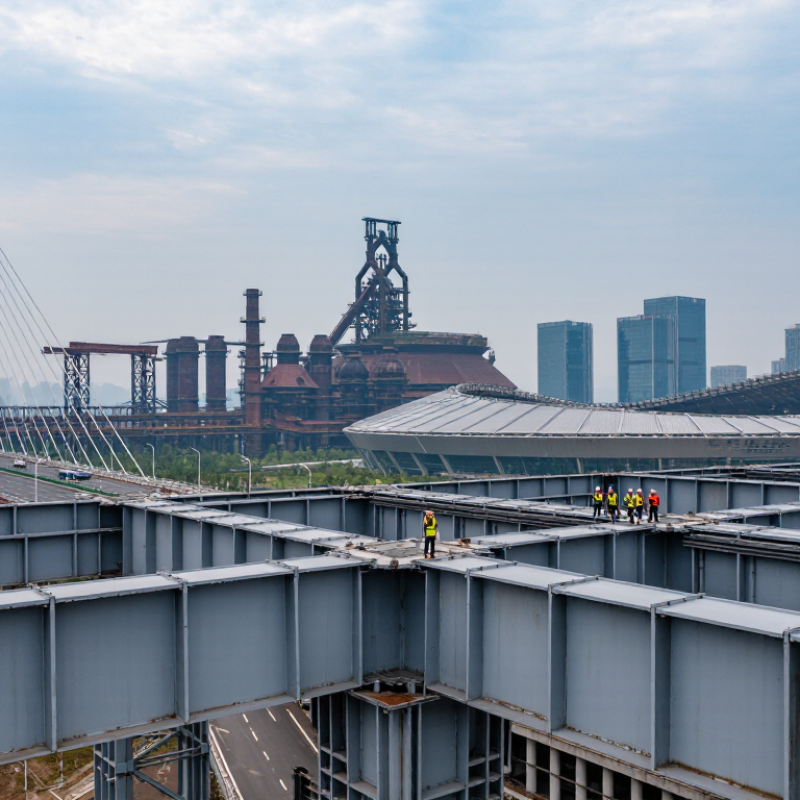
China’s steel structures serve factories, warehouses, bridges, stadiums, and high-rise buildings. Each type responds to a different load, space, and construction need. Portal frames are common in industrial workshops. Their rigid joints create wide, column-free interiors for machinery and storage. Steel trusses support larger roofs, especially in exhibition halls and transport facilities. They distribute weight through triangular members, reducing bending stress.
High-rise buildings often use steel frames, sometimes combined with concrete cores. This arrangement improves height, wind resistance, and construction speed. Space frames are also used for airports and sports venues. Their three-dimensional geometry covers broad areas with fewer internal supports. For bridges, box girders and cable-supported steel systems provide strength across long spans. Durability depends on more than structural form. Humidity, salt exposure, drainage, weld quality, bolt tightening, and protective coatings all matter. A strong design can still fail early when water remains trapped at a joint.
Tips: Match the structure to its environment, not only its budget. Inspect coating damage after transport and installation. Keep drainage paths clear. In coastal areas, use suitable corrosion protection and schedule regular inspections. Engineers should verify local wind, snow, seismic, and fire requirements before fabrication. Site observations often reveal small issues that drawings miss. Some projects still rely too heavily on initial calculations. That deserves reflection. Good maintenance records, clear inspection intervals, and qualified supervision make durability more dependable.
| Steel Structure Type | Typical Applications in China | Common Structural Materials | Main Durability Risks | Effective Protection Measures | Important Design and Maintenance Factors |
|---|---|---|---|---|---|
| Portal Frame Structures | Industrial workshops, warehouses, logistics buildings, agricultural facilities and commercial halls | Welded or hot-rolled I-sections, tapered columns and rafters, cold-formed purlins; commonly specified structural grades include Q235 and Q355 | Atmospheric corrosion, condensation beneath roof sheets, water accumulation at joints, coating damage and excessive wind or snow loading | Multi-coat paint systems, hot-dip galvanizing for suitable secondary members, effective roof drainage, sealed penetrations and correctly detailed connections | Site exposure category, ventilation, drainage, connection detailing, corrosion allowance, inspection of roof leaks and periodic coating repairs |
| Steel Roof Trusses | Large-span factories, sports facilities, exhibition buildings, railway halls and airport terminals | Angle sections, hollow sections, welded box members and circular tubes connected by bolting or welding | Corrosion at concealed nodes, fatigue caused by vibration or repeated loads, water leakage and difficult access for inspection | Sealed or well-drained hollow sections, suitable primer and finish coats, protected welds, adequate inspection access and moisture control | Long-span deflection, fatigue-sensitive details, weld quality, connection eccentricity, roof drainage and safe access for periodic inspection |
| Space Frame Structures | Stadium roofs, transport hubs, public atriums, convention centers and large canopies | Circular hollow sections, steel nodes, bolts and prefabricated three-dimensional modules | Moisture trapped around node connections, coating deterioration, bolt corrosion, membrane or roof leakage and difficult maintenance access | Durable coating systems, corrosion-resistant connection details, drainage around nodes, protected bolts and planned access platforms | Three-dimensional load distribution, connection tolerances, local buckling, environmental exposure, inspection intervals and replacement access |
| Steel Frame Buildings | Office buildings, residential towers, hotels, hospitals and mixed-use developments | Rolled or welded beams and columns, bracing systems, composite floor decks and high-strength bolts | Corrosion in humid or polluted environments, fire exposure, fatigue at heavily loaded connections, differential movement and construction defects | Fire-resistant coatings or encasement, protected façades, controlled indoor humidity, durable paints and inspection of bolted and welded joints | Fire-resistance rating, seismic detailing, wind response, drift control, load-path continuity, quality assurance and planned refurbishment |
| Steel–Concrete Composite Structures | High-rise buildings, bridges, industrial floors, parking structures and infrastructure projects | Steel beams or columns combined with reinforced concrete slabs, shear connectors and reinforced concrete encasement where required | Chloride ingress, carbonation, cracking, trapped moisture at interfaces, corrosion of exposed steel and deterioration of shear connectors | Adequate concrete cover, low-permeability concrete, crack control, waterproofing, drainage and protective treatment for exposed steel | Composite action, interface detailing, concrete quality, exposure conditions, differential shrinkage, fire performance and inspection of cracks |
| Steel Bridges | Highway bridges, railway bridges, pedestrian bridges and urban viaducts | Plate girders, box girders, trusses, orthotropic decks and weather-exposed structural steel | Chloride-related corrosion, fatigue from repeated traffic, coating breakdown, water leakage at expansion joints and de-icing chemicals | High-performance protective coatings, sealed drainage details, regular washing in aggressive environments, fatigue-resistant connections and timely repairs | Traffic fatigue spectrum, weld geometry, corrosion-prone details, expansion-joint performance, drainage, inspection records and load monitoring |
| Steel Towers and Masts | Communication towers, observation structures, lighting towers, transmission support structures and wind-energy towers | Galvanized angle sections, tubular members, flange connections, anchor bolts and high-strength fasteners | Wind-induced vibration, corrosion at bolted joints and bases, lightning exposure, coating damage and foundation water ingress | Hot-dip galvanizing, sealed base details, corrosion-resistant fasteners, drainage, lightning protection and regular bolt-torque inspections | Wind and seismic actions, fatigue, slenderness, foundation drainage, galvanizing thickness, access safety and periodic structural surveys |
| Light-Gauge Cold-Formed Steel Structures | Residential buildings, modular buildings, partitions, roof systems and small commercial structures | Thin-walled galvanized steel C-sections, Z-sections, tracks, panels and self-drilling fasteners | Local buckling, fastener corrosion, cut-edge corrosion, condensation and reduced performance caused by water intrusion | Continuous vapor and moisture control, protected cut edges, compatible fasteners, adequate ventilation and careful detailing around openings | Section slenderness, thermal bridging, screw spacing, bracing, galvanizing quality, moisture management and inspection of envelope defects |
Durability depends on the combined effects of material quality, structural design, fabrication, construction quality, environmental exposure, fire protection, drainage and maintenance. Project-specific service-life requirements should be verified against applicable Chinese standards and the actual site conditions.
Steel grade sets the starting point for durability. Higher strength may reduce member sizes. Strength alone cannot prevent corrosion or cracking.
No. It confirms important material information, but it is not complete proof. Independent testing should verify composition, strength, toughness, and weldability.
Incorrect plate thickness, uncontrolled heating, poor welding, and inaccurate dimensions can weaken a structure. Small weld defects matter. So does trapped water.
Coastal sites face salt spray. Northern sites may experience freeze-thaw cycles and dry winds. Design should consider loads, vibration, drainage, and thermal movement together.
Closed cavities, sharp corners, and water traps can accelerate hidden corrosion. Bolt connections and cut edges also need careful review. Drawings may miss field problems.
Workers should control welding, bolt tightening, surface cleanliness, and dimensional accuracy. Damaged coatings need immediate repair. Steel should not sit directly on wet ground.
Options include galvanizing, zinc-rich primers, intermediate coats, and durable finishing layers. The system must match the exposure environment. One coating system will not suit every area.
Inspect coating thickness, welds, connections, scratches, and concealed joints. Keep drainage openings clear. Schedule visual checks and thickness measurements, then repair damage quickly.
No. A strong grade cannot correct poor welding, weak drainage, or damaged coatings. This is easy to underestimate. Project teams should review uncomfortable details before installation.
Steel structures are widely used in China for industrial buildings, warehouses, bridges, high-rise frames, and public infrastructure because they offer strength, flexibility, and efficient construction. Their long-term performance depends on several connected factors. The steel grade, material consistency, welding quality, fabrication accuracy, and construction standards all influence the structure’s basic reliability. Different structural forms and applications also require suitable materials and connection methods.
Understanding what affects the durability of steel structures requires careful attention to the service environment. Humidity, rain, salt exposure, temperature changes, industrial pollutants, and other corrosive conditions can accelerate deterioration. Effective design should control water accumulation, improve drainage and ventilation, and allow easy inspection. Protective coatings, galvanizing, fire-resistant treatments, and properly sealed connections can further extend service life. Regular inspections should identify rust, coating damage, deformation, loose connections, and fatigue-related problems. Through planned maintenance, timely repairs, and ongoing service-life management, steel structures can remain safe, functional, and durable for many years.

 Sandstorm Steel